Ladies, to start your marriage out on the right foot – literally, wear the right shoes that you can dance in. This goes from wearing the same dance shoes to your lessons as you practice your first dance together and on your wedding day.
As a (former) competitive Ballroom dancer with 7+ years of experience, basically a short lifetime spent in 2.5″ heels, my advice is to chose ballroom dance shoes for your wedding because they’re designed to be danced in and, once broken in, are comfortable to wear for hours.
What follows is my social proof. My competitive dance partner was a part of our wedding and we performed a few of our dances together in a small showcase.


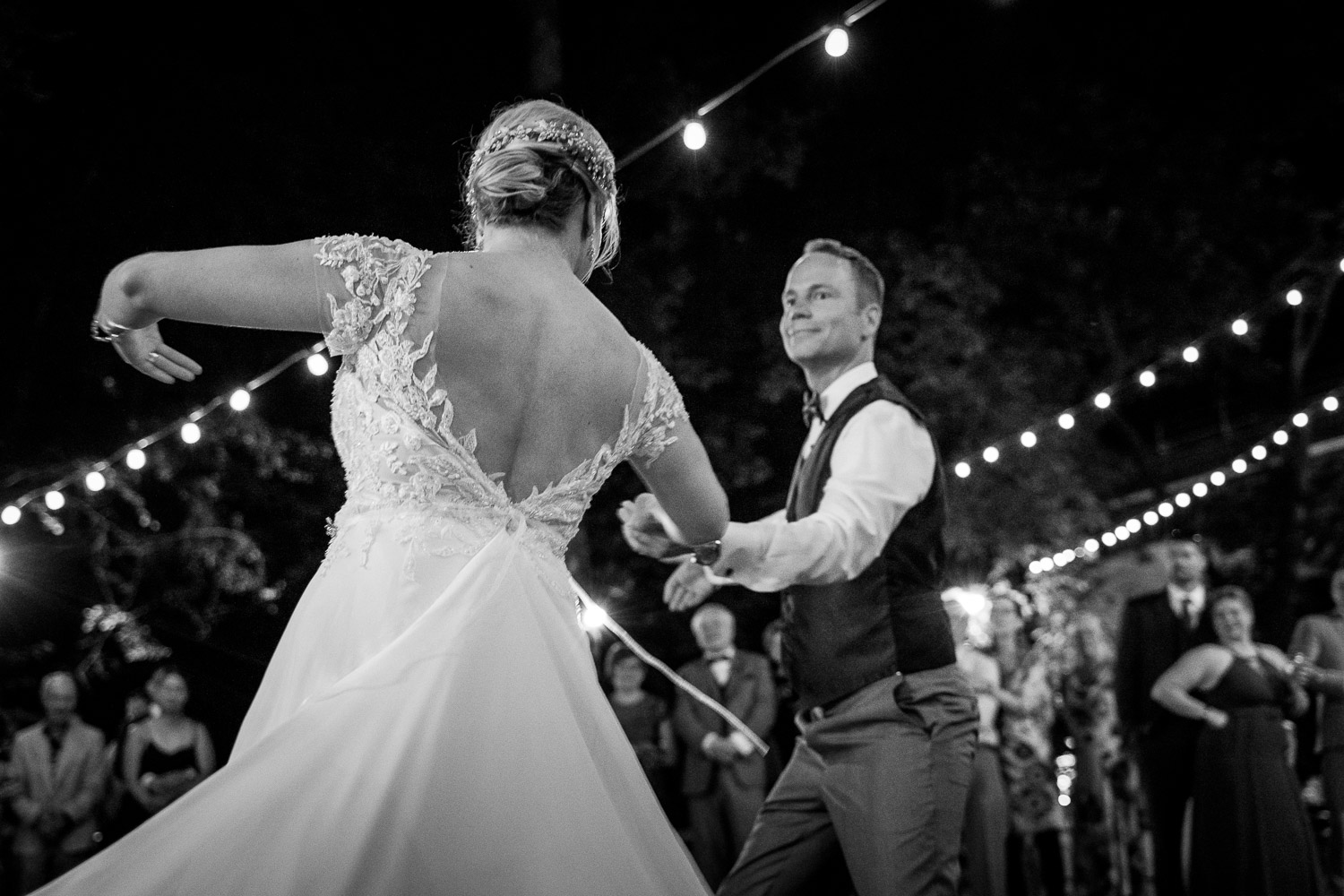
For our wedding, I made a few decisions about my footwear given things like, our chosen outdoor location, time of year and type of first dance we’d be doing.
I wore a ladies latin shoe in a blocky heel that I found in satin blue that matched our wedding colors. Because we were outdoors during August, I wanted to be able to wear a sandal for the entire night since we did both the ceremony and celebration in the same location.


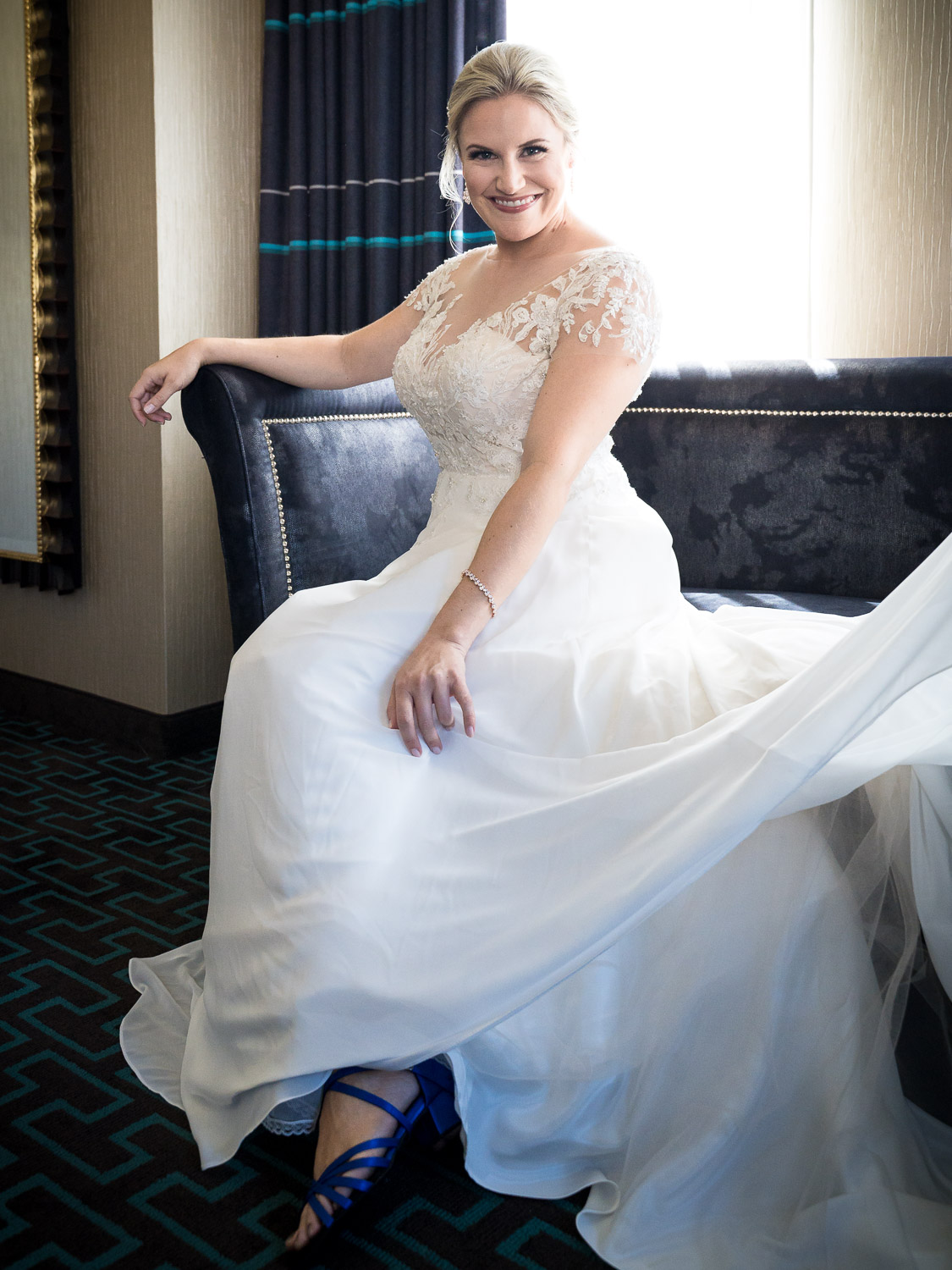
How to chose comfortable wedding dance shoes
The saying goes: Choose the right tools for the job. For the “job” of the bride, it’s about comfort and style throughout the wedding day.
Below are high level recommendations on what type of ladies shoe brides should wear given the type of music chosen for your first dance song.
| Type of Ballroom Dance |
Song examples | Recommended Ladies Shoe |
| Waltz | “A Thousand Years” Christina Perri (from Twilight: Breaking Dawn) | Closed-toe, heel height should be about 2-2.5” |
| Foxtrot | “Amazed” Lonestar “The Best Is Yet to Come” Frank Sinatra | Closed-toe, heel height should be about 2-2.5” |
| Swing | “How Sweet It Is (to Be Loved by You)” Marvin Gaye | Closed toe, with a low or wide heel |
| Cha Cha | “You Are the Best Thing” Ray LaMontagne | Open toe, 3” heel is ok. But if you’re dancing this slower foxtrot beat, opt for a closed-toe, lower heel. |
| Night Club/ Country Western Two Step | “God Gave Me You” Blake Shelton “Bless the Broken Road” Rascal Flatts | Anything flat. Cowboy boots or a low, wide heel |
For instance, if you’re choosing a more traditional song like the waltz, tango or foxtrot you could pair a 2 – 2.5″ high heel as you’ll mostly be on the balls of your feet.
If you’re choosing a latin style song, like a cha-cha or rumba, you’ll want an even higher heel of 3″ as that’s the style of shoe that best articulates the leg movement of those dances.
Lastly, there’s a lower, more blocky heel for swing dances or two step. It’s sometimes called a Cuban heel. Those can be either a closed toe or open toe shoe.
Shoe or song first?
It’s a tough call because I’m a bit biased. But I will advise that you and your spouse try to land on your first dance song together first so that it then informs things like your shoe type and whether or not you actually want choreography.
Heel heights in ladies ballroom shoes range from low, to medium, to high. In some cases, faster paced songs like a swing dance, are better in a lower heel. Whereas a latin and rhythm style song is going to need the higher heel.
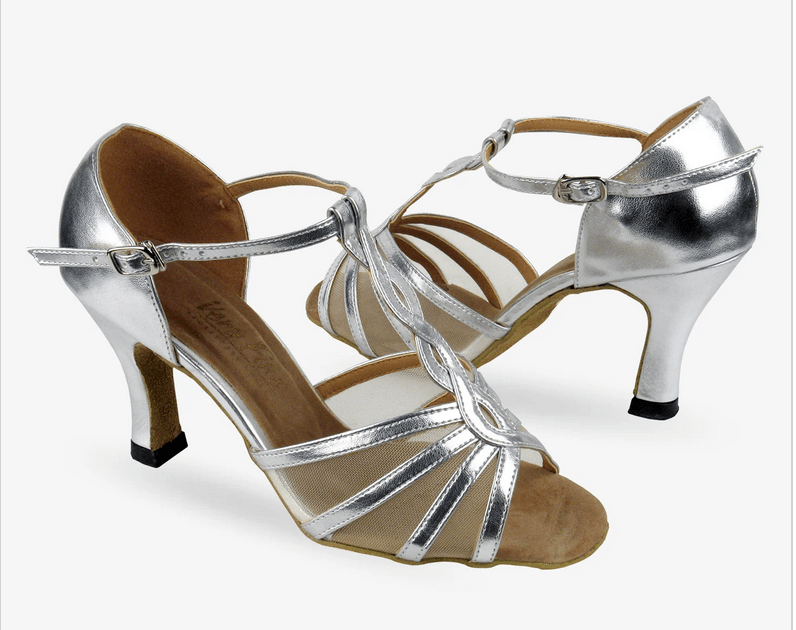
Ladies latin/rhythm shoe, 2.5 -3″ heel
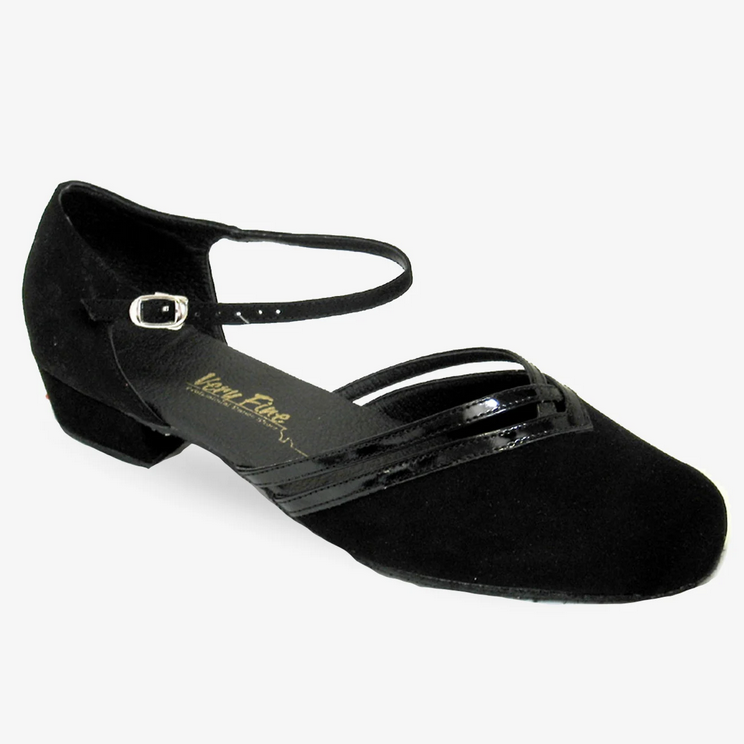
Closed-toe, ladies practice Cuban heel
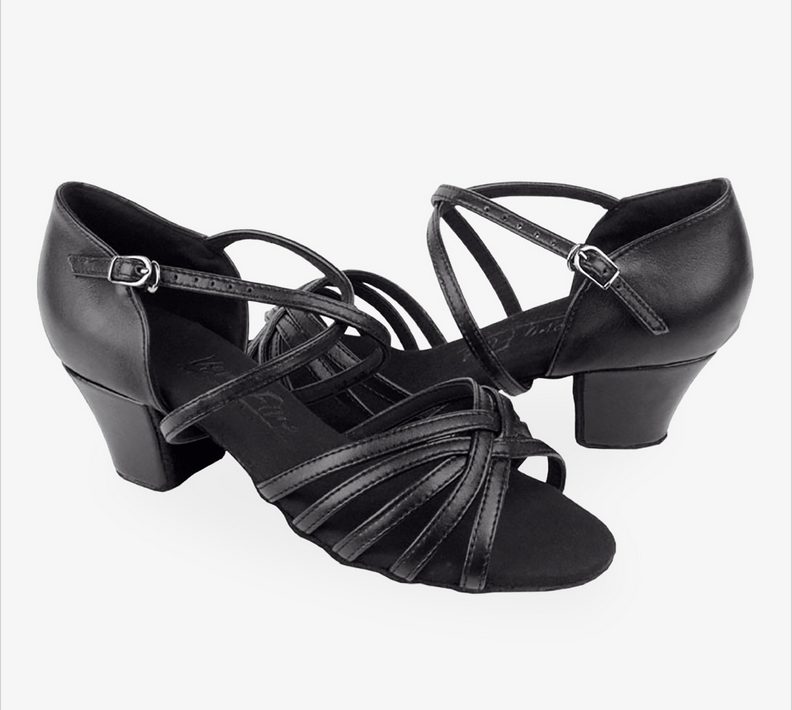
Open toe, ladies practice Cuban heel
For competitive ballroom dancers dancing Standard or Smooth, the typical shoe is a ladies closed toe ballroom tan stain heel. One could add rhinestones to this shoe as needed but the idea is, in the ballroom world, that this is an aesthetically pleasing shoe to wear to perform in because it visually extends the length of the legs and is worn occasionally during practice to help break them in.

Ladies ballroom tan stain 2″ heel
For reference, these images were sourced from Discount Dance which has lots of ballroom style shoes to browse and try.


I wear a brand called Stephanie Dance Shoes. If you happen to be in southern California where I trained as an amateur competitor, there’s a reputable ballroom vendor called, Notably Unique. They ship around the country. A typical pair will run about $139.00 USD. Again, they’re great to buy at the beginning of your lessons so that you can gradually break them in leading up to your big day.
Consideration: dress & hem length
It’s very likely every bride will need to have her wedding dress taken in and/or hemmed at the bottom. Given that brides can find their dress at any point, one consideration is to bring the shoes you plan to wear for the wedding (and practice in!) to all hemming appointments.
This helps ensure the gown is hemmed to the correct length given the heel height.
Now, you could be one of those brides that wants to change her wardrobe for the first dance or have a second reception dress. Sky’s the limit. If you do that, make sure your gown isn’t dragging all over the floor because you danced in a 3″ heel and then put on sneakers or flip flops afterwards. Or live with those consequences I guess.

Consideration: who else will you be dancing with on your wedding day?
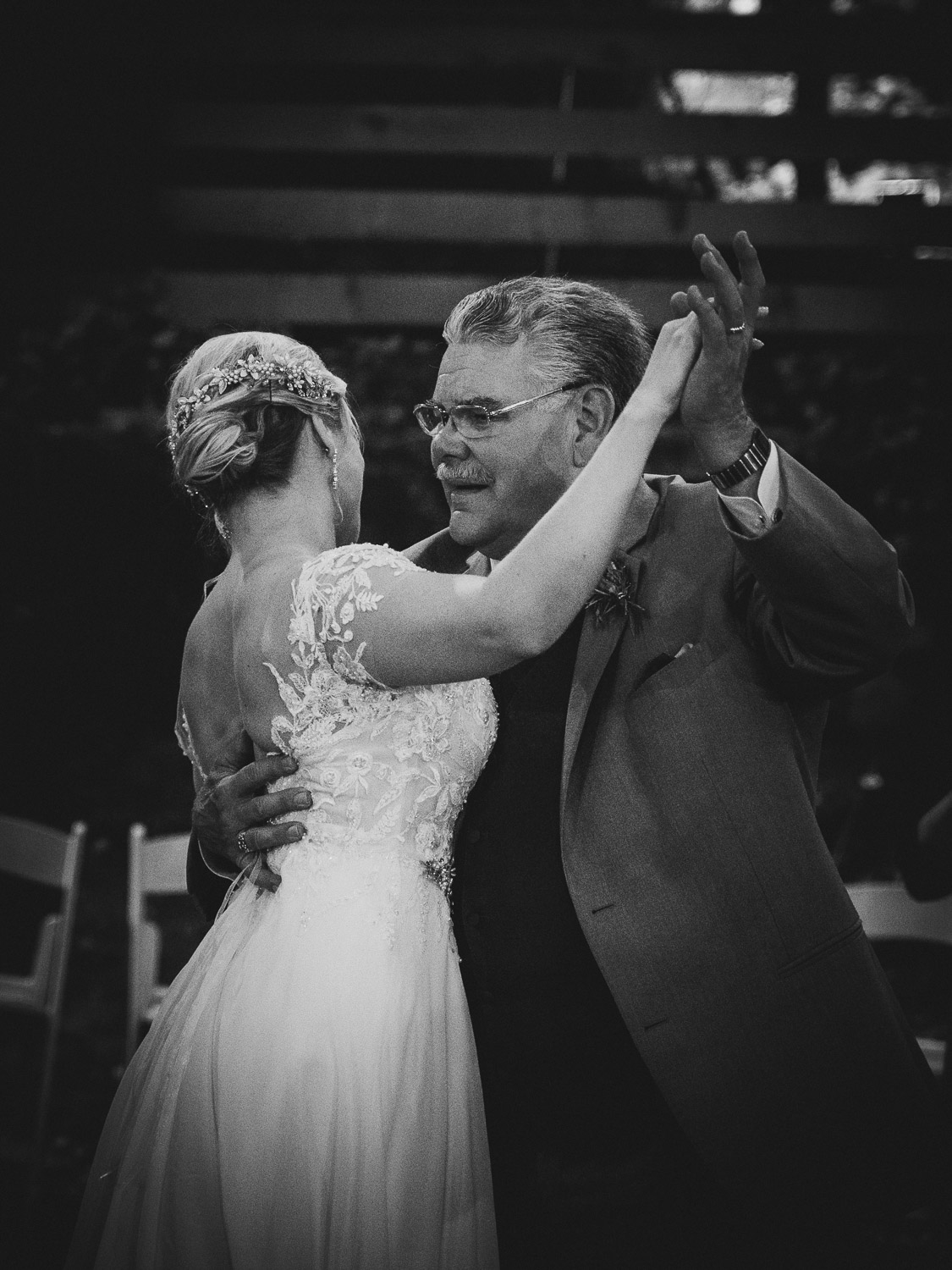
Another reason to chose the right shoes for your wedding is that you’ll likely be dancing with multiple people from your own father, new father-in-law to friends and family. You need a comfortable, stable shoe that will help you keep your balance no matter who asks to lead.

Why I had to write this article
When I was at a ballroom practicing with my competitive partner, I would often see wedding couples in the corner with another teacher and I would always observe the ladies footwear. It blew my mind to see bride after bride teetering on glittering stilettos or getting her toes stepped on in sandals.
As someone who used to spend 3+ days in the ballroom, I only wore practice shoes or competition shoes.
It seemed to me like many women were choosing their shoes first but going about it the wrong way.
They were sold on some version of a Cinderella shoe that was impossible to actually dance in.
Social Dancing—Like a Marriage— Is a Partnership
Marriage is a partnership. So, while it is your special day, it’s also your partner’s big day and the start of your days together henceforth and happily ever after. Partnership, to me, means you think about the other person as much, if not more than, yourself.
Partnership dancing, such as ballroom, is an amazing activity that can strengthen any relationship. On the other hand, if you and your partner are not on the same page, dancing in close proximity is also a speedy way to end a relationship.
For many wedding couples, their first dance as husband and wife is their first foray into the world of partnership dancing. Some couples manage to survive by hanging onto each other and swaying back and forth, some like to have their steps choreographed, and others invest in ballroom dance lessons a few months prior to their big day.
But my advice is for the ladies and bride-to-be reading this is: wear shoes to your lessons that you can actually dance in. Ideally, it’s the same shoe you wear on your wedding day/night for your first dance. Or it’s at least the same size heel.
How soon before my wedding should I begin taking dance lessons?
IMO, no couple ever came in early enough. This is something I wish people would do sooner rather than later. Far too often, couples would be weeks away or three months out. In my opinion, neither of those is nearly enough time, especially if you’ve never danced before.
I would say from the moment you get engaged and you know you want to have that first dance moment with your romantic partner, book yourselves at a local ballroom studio within a month. There are already a million other things to do as a bride and groom that will require your attention and decision. If you invest early in taking lessons or simply going to social group dances you’ll get extra practice time leading up to your big day when all eyes are on you.
Then, as you get to 6 months out, you can formalize your choreography with a ballroom professional as it will take you both an investment of time and finances to buy the right shoes. Most wedding couples take one lesson per week and are encouraged to practice together on their own at home. But, how many couples actually do this?
I think for those that have never danced before, start taking basic group classes once you’re engaged. 6 months out from the wedding is when you should consider getting choreography in place and making a plan to practice 2x per week so that you can fully enjoy dancing in front of your invited guests.
Let’s be honest, you’re paying for dance lessons…so use your time and money to learn how to dance.
Your practices will be so much smoother with the proper shoes because ballroom style shoes are designed to glide as you make contact on wooden floor; the bottom is leather as opposed to rubber.
Learning a skill like ballroom dancing together as a romantic couple is something you’ll both be able to do together throughout life. Take advantage of the fact that you’re likely also learning the basics of a waltz box step or a foxtrot. Many ballroom dances are also social dances and the lessons of being a good leader, as a man, or follower, for ladies, translates to social dancing.
Ballroom shoes are the best wedding dance shoes because they are built to be danced in
In closing, do your marriage and your romantic partner a favor and chose to wear shoes you can actually dance in to your lessons, during practice and at your first dance together as a married couple. With the right ballroom shoes, you’ll be in a far better position (quite literally) to manage your nerves, your dress and all the wedding day things in addition to executing the choreography you’ve paid for with your hard earned money.
You can always get ballroom heels to dance in that are the same height as the heels you’d like to wear during the rest of your ceremony, for pictures, etc. Ultimately, with the proper shoes, both individuals are able to maintain their own balance which means two strong individuals can come together as one. Now that sounds like a great way to start a marriage!
Holly Miller has been competing in ballroom dance competitions since 2004. She trains weekly with her coach and dance partner in Los Angeles. Follow Holly on Twitter @millertime_baby

 It's Miller Time Baby